
When AI Eats Software, What’s Left? Workflow Understanding as the Last Moat
The Bet
In 2023, three Yale data scientists — David Hidalgo-Gato, Jackson Pullman, and a third co-founder — formed Cleo Health on the heels of the ChatGPT release. The premise was deliberately broad: take generative AI and make healthcare better. The execution was deliberately narrow: pick one specialty, go a mile deep on its workflow, and build outward from there.
The specialty they chose was emergency medicine. The bet they made was unfashionable. Over 100 companies are now building AI ambient scribes, most of them retrofitting outpatient designs for every specialty under the sun. Cleo went the other way.
Why ED Breaks Generic Scribes
Three structural features of emergency medicine make it different from the workflows that ambient scribes are built around. The first is unscheduled flow: a clinician may see no patients for twenty minutes and then five in the next ten. The second is multi-session encounters: in a single ED visit, a physician may revisit and append a patient’s note three to five times as labs and imaging come back. The third is billing. Emergency medicine has its own CMS framework, called Medical Decision Making, with three categories — complexity of problems addressed, complexity of data, and risk of complications — and obscure rules attached to each. As David puts it, MDM “is just grossly misunderstood by not just other ambient listening companies within the space, but really, it’s very specific to emergency and hospital medicine.”
A generic scribe trying to bolt onto this workflow loses the multi-session structure, the billing logic, or both.
Listening as the Discipline
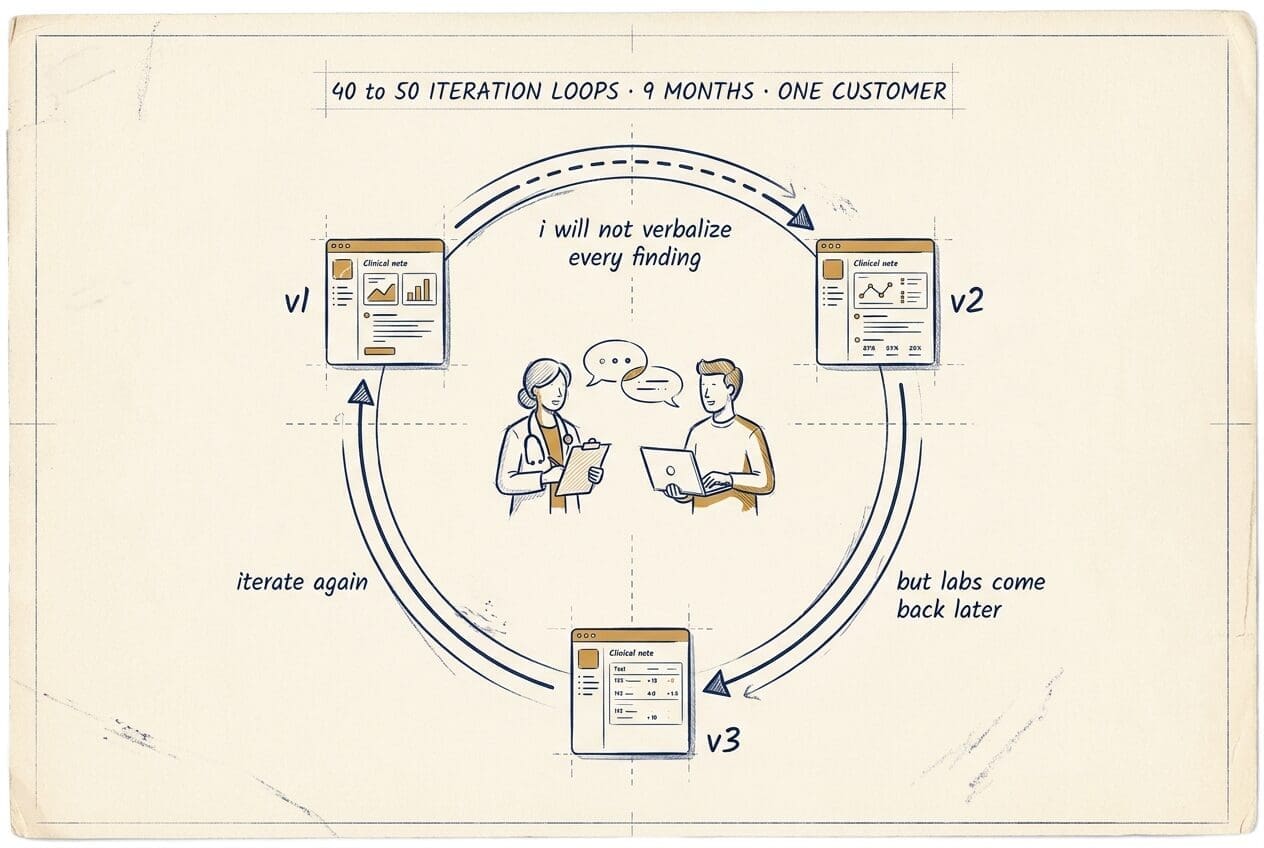
Cleo’s first customer was a private physician group in Colorado. They stayed with that one customer for nine months. During that time they ran 40 to 50 iteration loops. V1 of the product had a verbalized-exam section; the clinicians said they were not going to dictate every finding, so V2 auto-populated a normal exam template. The clinicians then said the note was incomplete because labs came back hours later, so V3 added timestamped reevaluations. The pattern repeated dozens of times.
David’s framing of why this matters: “We clearly do not know, never will know, as much about the best way to use our product as the users of our product. Because of that we have had to listen extremely carefully and develop these tight feedback loops.”
Where AI Fits, and Where It Doesn’t
That same discipline produced one of the most useful framings of the conversation. The strongest fit for generative AI right now, David argues, is problems where being wrong is recoverable: “the best use cases for AI are where AI can be wrong and it’s okay.” Pair that with workflow understanding, and you have a method for selecting where to deploy.
A second observation followed. Cleo’s automated patient-assignment tool turned a four-hour manual scheduling process into 15 to 20 minutes. Why generative AI in healthcare rather than a classical optimization algorithm? Because each hospital’s rules are snowflakes — “I want Dr. Labkoff to see patients on floor seven because he has nine patients there.” Free-text rules need a model that can map them into a structured assignment. The flexibility of input is what makes this a generative AI problem, not a constraint-solving problem.
The Moat
By selling first to private physician groups (CarePoint, ApolloMD, Core Clinical) rather than directly to hospitals, Cleo gained warm exposure inside health systems it never sold to. Its published footprint is 100+ hospitals nationwide; David puts it at roughly 40% of US emergency-department groups. The company recently launched what it calls the Acute Care OS, bundling ambient documentation, charge capture, clinical documentation integrity, and patient assignment.
The deeper claim under all of this is that AI commoditizes development but not workflow understanding. When coding is no longer the bottleneck, what differentiates a healthcare AI company is whether it actually knows where to look and which conversations to have. As David put it when asked what keeps him up at night: “It is inevitable that the world looks almost unrecognizable in five years relative to today. What is unclear is whether that new world is going to be a better world or a worse world.” The workflow-understanding thesis is, in part, a bet on which side of that line healthcare ends up on.
Listen to the full conversation.
You Might Also Enjoy
- S1E33 with Ted Shortliffe — The fifty-year view of clinical AI. Cleo’s “workflow understanding is the moat” thesis is a contemporary echo of Shortliffe’s argument that you cannot build clinical AI without lived domain understanding.
- S1E24 with Bob Wachter — The Digital Doctor revisited. Cleo’s “don’t give our hospitalists another app” insight is the field-tested counterpart to Wachter’s critique of EHR-era workflow fragmentation.
- S1E15 with Adam Rodman — Clinical reasoning and AI. Adam’s thinking on where AI augments diagnostic reasoning pairs naturally with David’s “AI can be wrong and it’s okay” framework for where generative AI actually fits.