
The Patient Is the Forgotten End-User of Clinical AI
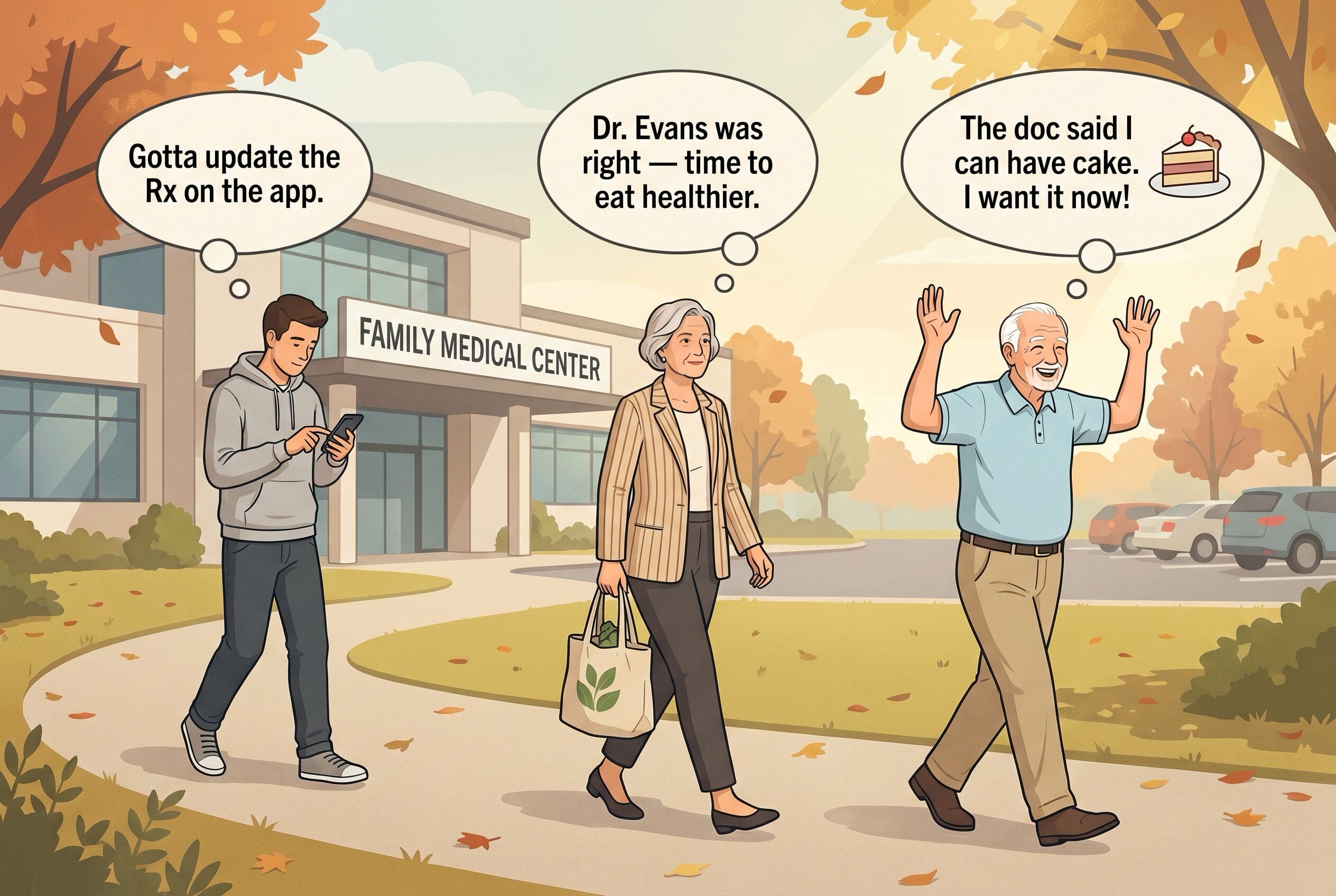
When Fred Bennett’s father came home from a cardiology follow-up, the family held an impromptu debrief in the car. Fred, a pharma veteran, heard “new medications, let’s hit the pharmacy.” His mother heard “Mediterranean diet, let’s clean out the fridge.” His father heard one thing only: “the doctor said I can have cake.”
Three people. One 30-minute visit. Three different conversations.
That gap — between what a doctor says and what a patient actually hears — is the problem Bennett built a company around. For our first-ever live episode, recorded before an audience at New York Tech Week, we talked with the founder and CEO of Patient Talker, an ambient-AI app pointed at the patient instead of the clinician. (Full disclosure: Steve is an advisor to the company.)
Why the patient gets left out
Ambient AI in the exam room is a crowded field — Abridge, Suki, Nabla, Nuance. Bennett is quick to say those tools solve a real problem: they cut a physician’s note-writing from hours to minutes. But notice who pays for them. “EHRs were built,” as Steve put it from years of building and implementing them, “largely for billing.” Tools follow incentives, and the patient’s comprehension has never been the line item anyone was funding. By Steve’s rough estimate from the work at Harvard, fewer than 10–20% of healthcare AI apps are patient-facing.
“The patient is the whole reason the healthcare system exists,” Bennett said, “but the patient is often an afterthought. That’s wrong.”
The moat isn’t the model
The obvious objection: couldn’t Epic or one of the funded scribes clone this in a sprint? Probably. “Technology is the cost of entry,” Bennett said, “but it’s not a barrier to entry.” The defensible part is deep knowledge of what a sick, anxious, distracted patient actually needs — and an honest answer to who pays. Bennett’s model keeps the app free to patients and looks to the parties whose incentives already align with better outcomes: health systems and payers who own both the result and the financial risk of a readmission.
Build the minimum trustable product
Asked what two years taught him, Bennett offered a builder’s reframe. Forget the minimum viable product. “It’s about the minimum trustable product. The first time someone uses this and it doesn’t work, they’re never gonna pick up your app again.” On the patient side, where the user is vulnerable and the cost of a wrong word (hypo- versus hyper-, a missed “not”) is real, trust is the entire game.
And the lesson under the lesson, one Steve has watched play out since his Pfizer days: the technology is almost never the rate-limiting step. Bennett spends roughly 20% of his headspace on the AI. The rest is patients, incentives, and the unglamorous work of earning trust.
Listen to the full conversation: https://practicalaiinhealthcare.com/episodes/#S1E42
You Might Also Enjoy
- S1E41 with Hugo Campos — A patient advocate building his own tools for personal data access; the patient-directed-AI counterpart to Bennett’s patient-side bet.
- S1E37 with Danny van Leeuwen, RN, BSN, MPH (Health Hats) — The patient’s point of view on AI tools, from someone who lives on both sides of the clinical conversation.
- S1E30 with Amy Price, DPhil — Patient advocacy, participatory medicine, and the governance questions that come with putting patients in control.