
One Record or Many? Adam Blum’s Bet on Replacing the Disposable Extract
When Adam Blum went to AMIA this spring, he stayed after every AI and machine learning session he could get to and asked the presenter one question: what percentage of your effort went to building and maintaining the flat projection? “Every single one said the majority,” he told us.
It’s an informal poll, and Adam has something to sell. He’s CTO of HealthKey.ai, which acquired his CancerBot this year. (Full disclosure: Steve advises HealthKey and co-authored the PRomop paper, now under review at JAMIA Open.) But anyone who has built a predictive model will recognize the answer.
One store instead of three
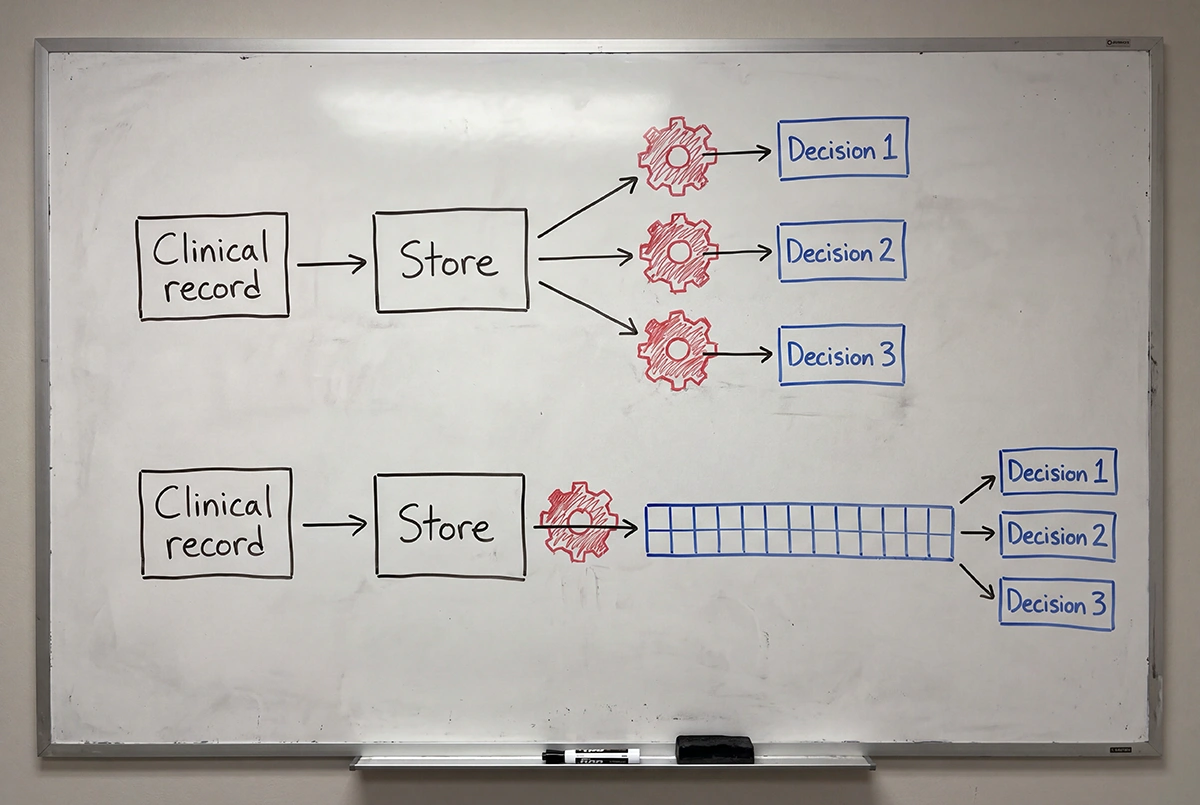
PRomop is Adam’s proposal: an open-source patient record built on OMOP, with a flat table on top, one row per patient and a column for each attribute that matters. “What if you could have one store instead of three,” he asked, so that nobody has to write ETL to get from a transactional store to an analytics store to something a decision can read?
How many tables?
Leon put the opposing view to him in its extreme form: if the shape of a record has to match the question, you would need as many flat tables as there are decisions. Adam thinks one per disease is enough. For follicular lymphoma, that’s 304 attributes.
His argument is that trial eligibility criteria are “close to a strict superset” of what standard-of-care decisions need. Leon’s gloss: trials ask about things that haven’t reached the standard of care yet. In theory, the questions are unbounded. In practice, per disease, he says they’re bounded. As Leon said at the close, that’s an empirical claim, “which means somebody could check it.”
Stale, and hard to get right
Steve and Leon have used flat projections themselves, and hit double counting and temporality problems. Adam’s answer is that this record is “not a generated flat file.” It updates as data arrives.
He also says speed isn’t the main benefit. The benefit is the code nobody has to write. His example is CRAB, the criteria for end-organ damage in multiple myeloma: hypercalcemia, or renal insufficiency, or anemia, or bone lesions. “It’s actually hundreds of lines of code,” he said, for one attribute. Done once and, ideally, reviewed by many people, it doesn’t have to be redone by each team, and possibly missed at the edges by a coding assistant.
Where the AI is
“The core of it,” Adam said, “is not AI.” It’s database work and well-checked code. AI helps suggest which OMOP concept a field maps to, a doctor makes the choice, and the harder lift is mapping proprietary hospital codes. His biggest long-term hope is for what the record enables: predictive models that retrain as new data arrives.
Leon also raised the cemetery of personal health records, including Google Health and HealthVault. Adam’s reply: HealthKey isn’t trying to be “the PHR in the sky.” It offers the software to foundations, and it charges those that want it hosted.
Where it runs out
Leon’s last question was where a 300-field record gives out first. Adam’s answer was the most practical of the hour. The science moves, so a clinician has to review the fields, “maybe once a month, once a quarter.” Configuration makes that cheaper, but as Leon had said earlier, the complexity “has to go somewhere.”
Listen to the full conversation: https://practicalaiinhealthcare.com/episodes/#blum
You Might Also Enjoy
- S1E28 with Adam Blum — The first conversation, on CancerBot and matching patients to trials, which is where this record began.
- S1E27 with Charlie Harp — A framework for measuring clinical data quality, for anyone mapping hospital codes.
- S1E45 with Mika Newton — How the Cures Act and TEFCA made full patient records reachable, and why “records travel, but they don’t translate.”