
What a Pair of Glasses Adds to an Autism Evaluation
A family that suspects autism usually starts at the pediatrician. From there, Erica Crawford told us, they get sent to early intervention, which offers services but no diagnosis, then back to the pediatrician, then into a choice between the school, a private psychologist, and a children’s hospital, each with its own limits and its own wait list. “They just wait and wait and wait.” The whole trip can take a year and a half to two years.
Erica is Clinical Director for Dallas–Fort Worth at AT4K (Autism Testing 4 Kids). Latha Valluripalli Soorya directs the AARTS Center at Rush University Medical Center and co-founded Argus Cognitive, which makes Neurora. AT4K was a reimbursed clinical site in Neurora’s FDA study.
Why the assessment is scarce
An autism diagnosis has three parts, Latha explained: a structured observation, a developmental history, and the clinician’s picture of the whole child. The observation is usually the ADOS-2, and its score never says yes or no. “Erica’s team gives you yes or no autism.”
The ADOS-2 is hard to give well. An IQ test runs in a fixed order. The ADOS-2 follows the child. “They’re interested in the ball, you go to the ball,” Erica said. That takes training, and few people have it.
What the glasses see
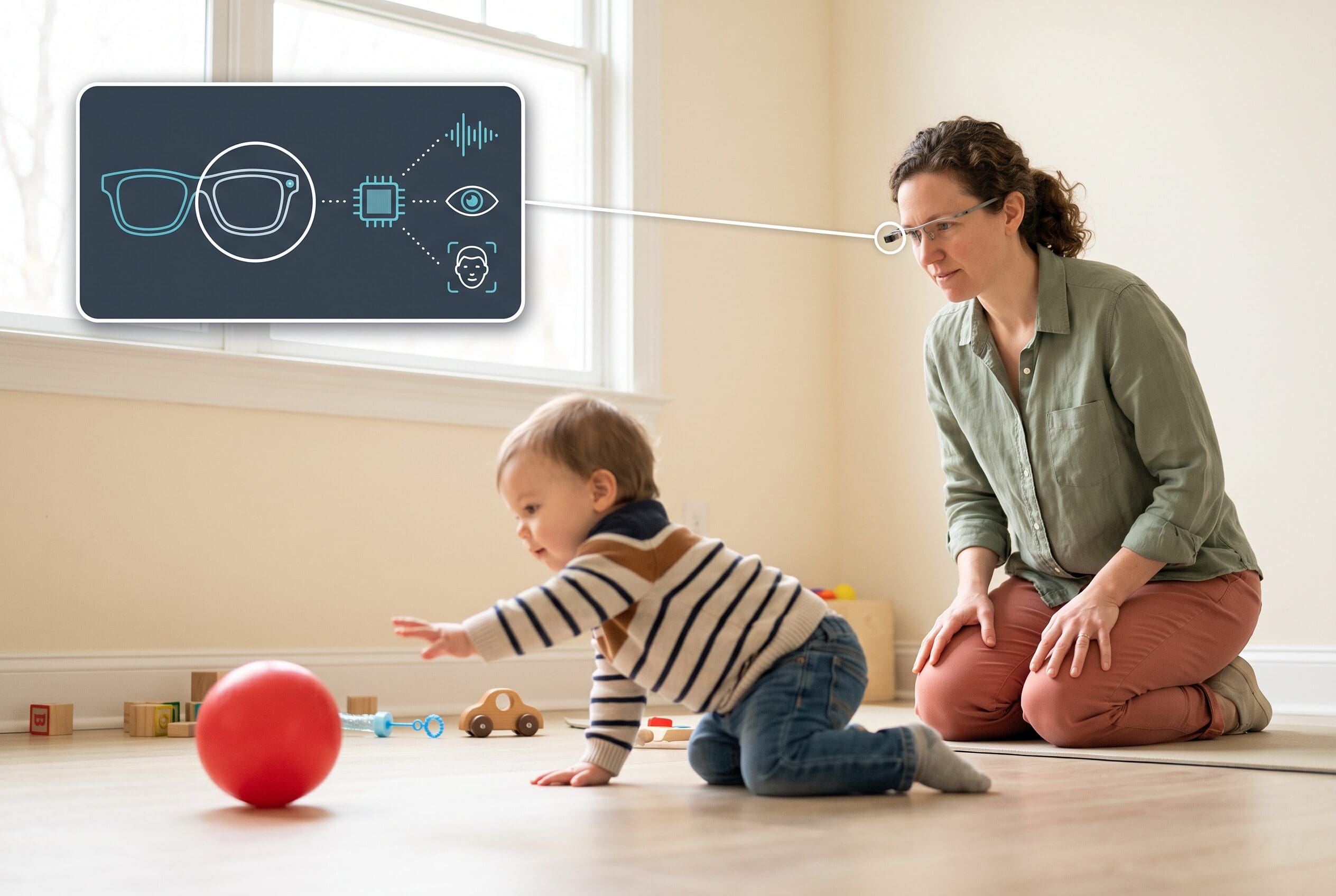
With Neurora, the examiner wears commercial smart glasses while a separate camera records the room. The software measures three things: gaze, facial action units, and speech. It doesn’t capture gestures or repetitive behaviors, which Latha named plainly.
What it adds is coordination. “We don’t just get are they making eye contact,” Latha said. It records who started the eye contact, when the child responded, and what the face and voice were doing at the same moment. Erica gets five scores (facial movements, gaze toward the clinician, vocal activity, pitch patterns, and an overall score), each with a cutoff, plus the video with those moments marked.
Leon asked whether those measurements are combined by arithmetic a clinician could trace, or by a second model. The answer was a model, because there are dozens of gaze and facial metrics to condense. That trades some transparency for precision.
Faster, or better?
Steve’s question was the obvious one: a person still has to see the child, so what moves? Erica’s answer was confidence on hard cases: the bright, verbal child who does well with adults, or the anxious girl who reads as shy. “I was so focused on what they were saying, I kind of maybe missed that.”
The time savings came from somewhere else. A separate AI tool cut her report writing from four or five hours to under one. Visits stayed at two or three. Latha hadn’t expected it.
What the evidence shows
In the published study’s held-out test, the model separated autistic from typically developing children with 72.1% sensitivity and 88.6% specificity. The gap shows in the non-autistic children: it classified 33 of 35 typically developing kids correctly, but only 15 of 24 with other conditions, such as genetic syndromes or ADHD. Latha’s summary: “It does a better job getting something, but not exactly what it is.” The study included fragile X from the start because that differential is the hard clinical call. Neurora is awaiting FDA clearance.
Leon’s view is that this is what tools are like. The question is the process around them: a clinician who makes the final call and knows where the tool errs.
Where it goes
Erica wants glasses on teachers and parents, because the breakdowns that define autism happen on busy school mornings, not in a quiet room. Latha wants better outcome measures, since autism research and reimbursement both suffer without them. Nobody has worked out who pays.
Listen to the full conversation.
You Might Also Enjoy
- S1E50 with Jeremy Harper — Ambient scribes and documentation time, the same back-office gain AT4K found in report writing.
- S1E46 with Peter J. Embi — How health systems should monitor AI tools that are useful and imperfect at the same time.
- S1E39 with Sarah C. Rossetti — Another case of turning what clinicians notice into a measurable signal.